
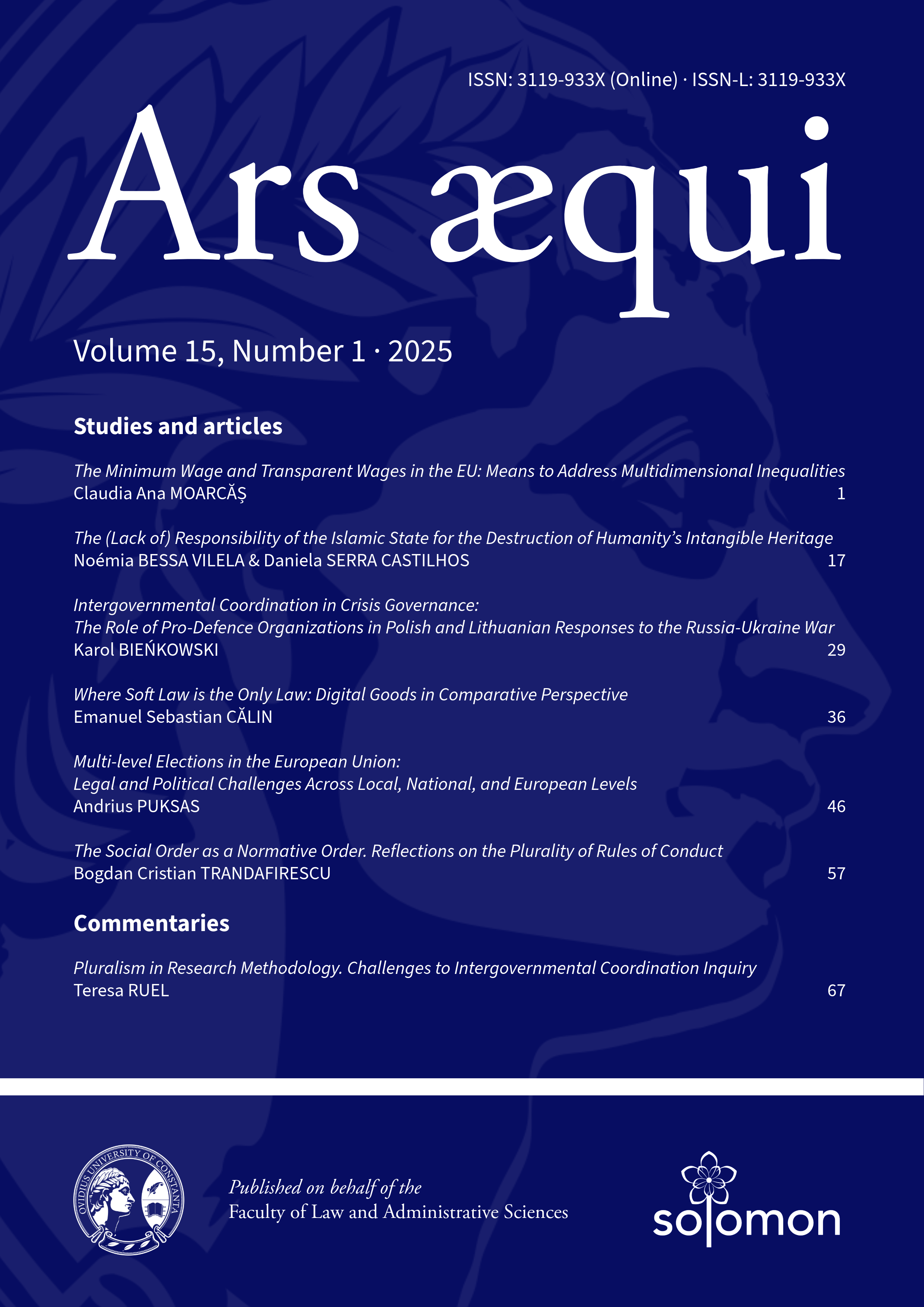
The (Lack of) Responsibility of the Islamic State for the Destruction of Humanity's Intangible Heritage
DOI:
https://doi.org/10.61801/Arsaequi.2025.274Keywords:
common heritage of mankind, cultural heritage, Islamic State, Daesh, state responsibility, individual criminal responsibility, International Criminal CourtAbstract
The intentional destruction of cultural heritage undermines human dignity, identity, and intergenerational continuity and, when committed in armed conflict, constitutes a serious violation of international law. Between 2013 and 2019, the so-called Islamic State (Daesh) conducted a systematic campaign of cultural destruction in Iraq and Syria, targeting monuments, religious sites, museums, and archaeological remains while simultaneously exploiting antiquities trafficking to finance its operations. This article examines how international law responds to such acts when perpetrated by a non-state armed group lacking international legal personality. Drawing on the doctrine of the Common Heritage of Humanity, UNESCO’s prohibition of intentional destruction, and developments in international criminal law, the paper analyses the allocation of responsibility between states and individuals for heritage crimes committed by Daesh. Using a doctrinal and case-law-based methodology, it assesses state obligations to prevent, protect, and repair cultural damage, alongside the emergence of individual criminal responsibility under the Rome Statute and domestic jurisdictions. The article argues that, notwithstanding Daesh’s non-state character, contemporary international law provides a coherent accountability framework that integrates state responsibility, individual criminal liability, and post-conflict restorative measures, reaffirming cultural heritage as a collective interest of humanity and a core component of international legal protection.
References
Brașoveanu F, ‘Considerations on Cultural and Natural Heritage and the Universal Obligation to Protect and Transmit It to Future Generations’ (2024) 26(1) Ovidius University Annals – Series: Civil Engineering 111 118 https://doi.org/10.2478/ouacsce-2024-0013
Brown EB, ‘Freedom of the High Seas versus the Common Heritage of Mankind: Fundamental Principles in Con-flict’ (1983) 20 San Diego Law Review 521
Buscher FM, The U.S. War Crimes Trial Program in Germany, 1946 1955 (Greenwood Press 1989, Contributions in Military Studies, No 86)
Ervin S, ‘Law in Vacuum: The Common Heritage Doctrine in Outer Space Law’ (1984) 7 Boston College Interna-tional and Comparative Law Review 424
Ferreira PG, “Responsabilidade Internacional do Estado” in JB Lima Jr (ed), Direitos Humanos Internacionais: Avanços e Desafios no Início do Século XXI (MNDH/GAJOP 2001) 22
Francioni F and Lenzerini F, ‘The Destruction of the Buddhas of Bamiyan and International Law’ (2003) 14(4) Eu-ropean Journal of International Law 619 651
Forrest C, ‘Cultural Heritage as the Common Heritage of Humankind: A Critical Re Evaluation’ (2007) 40 The Comparative and International Law Journal of Southern Africa 124 151
Joyner CC, ‘Legal Implications of the Concept of the Common Heritage of Mankind’ (1986) International and Com-parative Law Quarterly 190 199
Kiss AC, ‘Conserving the Common Heritage of Mankind’ (1990) 59 Revista Juridica de la Universidad de Puerto Rico 773 777
Knight G and Chiu H, The International Law of the Sea: Cases, Documents, and Readings (Elsevier 1991)
Larschan B and Brennan BC, ‘The Common Heritage of Mankind Principle in International Law’ (1983) 21 Colum-bia Journal of Transnational Law 305 337
Lefebver R, ‘The Exercise of Jurisdiction in the Antarctic Region and the Changing Structure of International Law: The International Community and Common Interests’ (1990) 21 Netherlands Yearbook of International Law 81 137 https://doi.org/10.1017/S0167676800002075
Murphy A and Stăncescu V, ‘State Formation and Recognition in International Law’ (2017) 7(1) Juridical Tribune 7
Nordquist MH (ed), United Nations Convention on the Law of the Sea 1982. A Commentary, vol 1 (Martinus Nijhoff 1985)
Powderly J, ‘Prosecuting Heritage Destruction’ in JC Cuno and TG Weiss (eds), Cultural Heritage and Mass Atroci-ties (Getty Publications 2022) https://www.getty.edu/publications/cultural-heritage-mass-atrocities/part-4/25-powderly/
Ramos AC, Responsabilidade Internacional por Violação de Direitos Humanos: Seus Elementos, a Reparação Devida e Sanções Possíveis: Teoria e Prática do Direito Internacional (Renovar 2004)
Ramos AC, Teoria Geral dos Direitos Humanos na Ordem Internacional (Renovar 2005)
Suter K, Antarctica: Private Property or Public Heritage? (Zed Books 1991)
Stein GJ, ‘Performative Destruction: Da’esh (ISIS) Ideology and the War on Heritage in Iraq’ in JC Cuno and TG Weiss (eds), Cultural Heritage and Mass Atrocities (Getty Publications 2022) https://www.getty.edu/publications/cultural-heritage-mass-atrocities/part-2/09-stein/
Weiss EB, In Fairness to Future Generations: International Law, Common Patrimony and Intergenerational Equity (Transnational Publishers 1989) 191
White MV, ‘The Common Heritage of Mankind: An Assessment’ (1982) 14 Case Western Reserve Journal of Interna-tional Law 509 542
White S, ‘Heritage in War: International Criminal Responsibility for the Destruction of Cultural Heritage in Armed Conflict’ in G Mastandrea Bonaviri and MM Sadowski (eds), Heritage in War and Peace. Legal and Political Perspec-tives for Future Protection (Springer, Cham 2024) 267 285 https://doi.org/10.1007/978-3-031-47347-0_18
Wolfrum R, ‘The Principle of the Common Heritage of Mankind’ (1983) 43 Zeitschrift für ausländisches öffentliches Recht und Völkerrecht 312 337
Downloads
Published
How to Cite
Issue
Section
License
Copyright (c) 2025 The Author(s), under exclusive license to Editura Solomon.

This work is licensed under a Creative Commons Attribution 4.0 International License.
.png)


.png)